Definition
Cellular automata are an array of cells, each being in one state out of many possible ones.
Every cell in the array evolves along a discrete timeline of "generations." For each generation,
what's called a "transition function" decides the cell's next state. The transition function does
this by determining the number of neighbors of each cell it affects. It also takes into account
the state of those neighbors.
Perhaps one of the most notable example of cellular automata is the Game of Life. The Game of Life features cellular automata
with 2 states: dead and alive (dead cells are black, and living cells are white). The Game of Life also features a simple
transition function, with a set of only 3 conditions:
Survival: a “live” cell with 2 or 3 neighboring “live” cells will live.
Death: a “live” cell with more than 3 neighboring “live” cells will die.
Birth: a “dead” cell with exactly 3 neighboring “live” cells will be born.
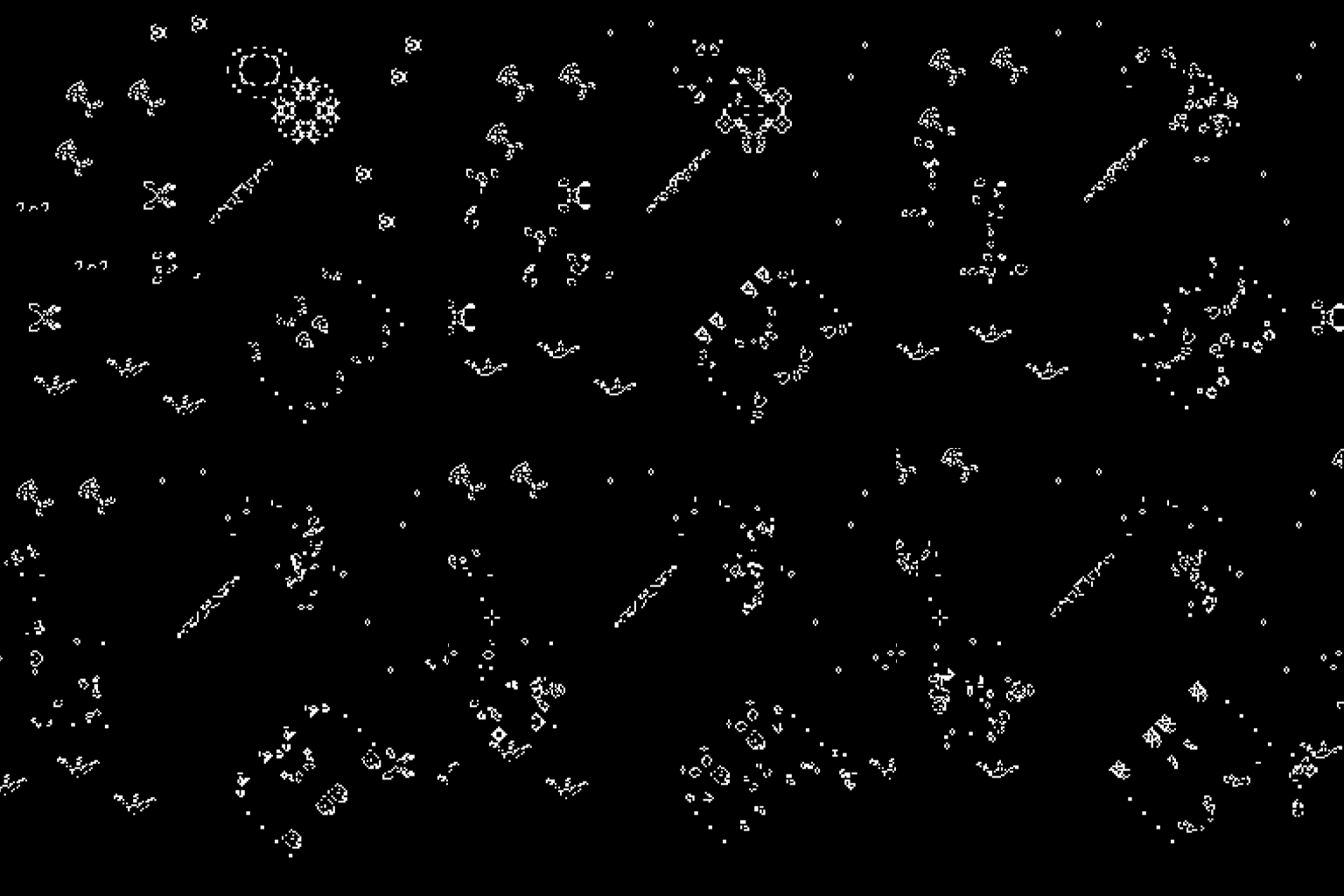
Fig. 2.1. displays an example of Conway's Game of Life.
The part that helped with this research the most is Von Neumann's Universal Constructor. It features 29 states
with a totally different way of defining a neighborhood (the Constructor features a neighborhood named after Von
Neumann himself). My research deals with the traditional 8-cell neighborhood, but I leaned into having more states
for my cellular automata to represent some basic expansion of territory in war.