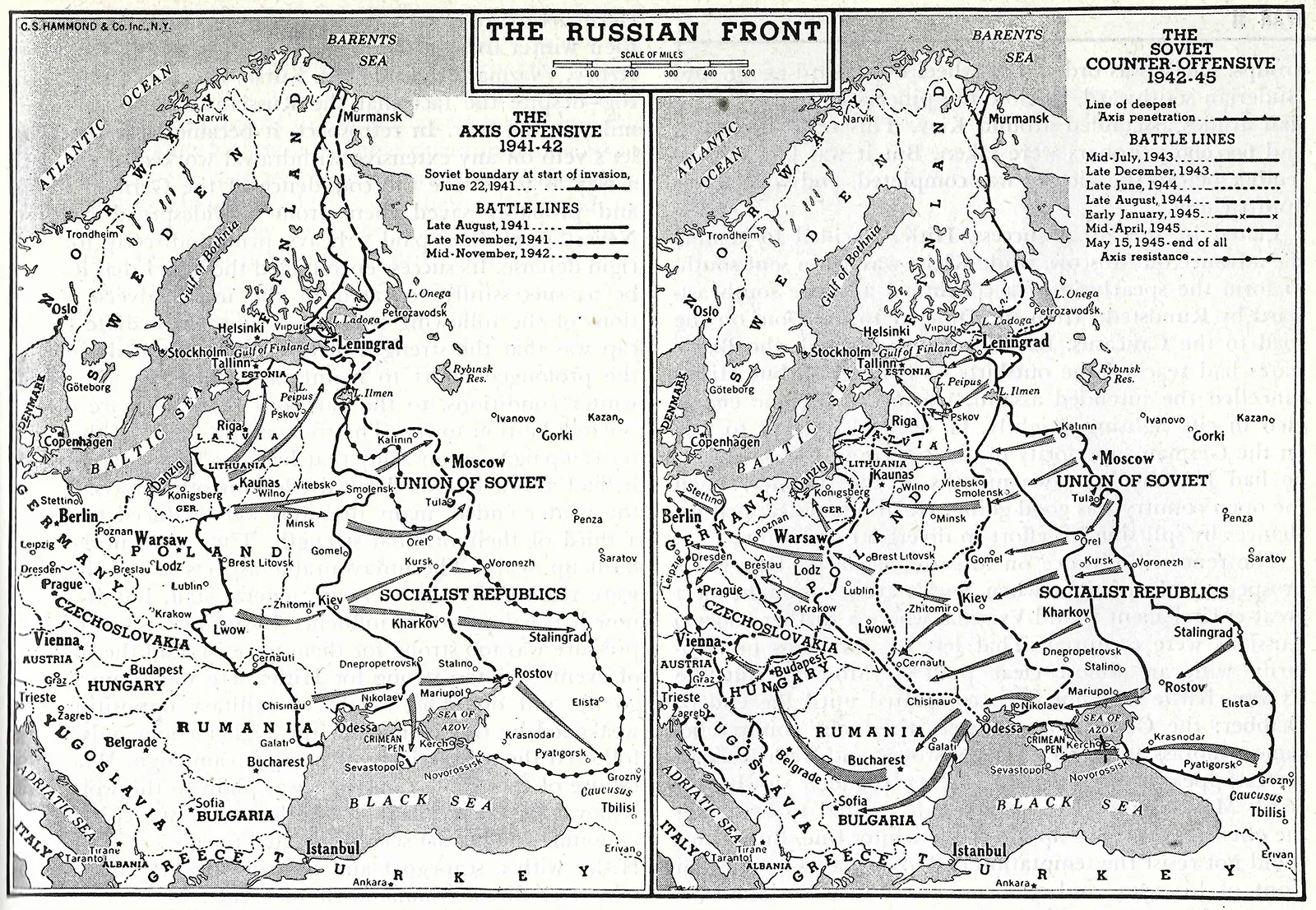
Operation Barbarossa started on the Eastern Front in June 1941, bringing swathes of Soviet land into German control until August 1941.
In Fig. 3.1., on the right section, German territories are represented on the left of the spiked line, and Soviet territories are represented on the right.
Not only that, Fig. 3.1., presents the frontline as the black line with spikes between the two colors. This is where the two “factions” will confront each other.
In my simulation, behind the frontline are supplies, which will nourish the frontline and prevent it from collapsing.
Not only that, between two factions, there needs to be a source for which an invading army comes from.
In the case of Fig. 3.1., the 3 army groups North, South and Center are deployed from various territories, such as Lithuania, East Poland, and Romania.
These locations will be called the “capitals” in my simulation, which provides a starting point for the armies.
In hindsight, my simulation was like one of those history videos that showed the expanding armies in 2 opposite colors, and they consistently push
back and forth in order to make advances towards the enemy bases and capital city. It was similar in a sense that I colored each cells differently.