Origins
Stumbling across the stunning patterns created by John Horton Conway's Game of Life, I began a deep dive into the
subject of cellular automata. A bit of history for you:
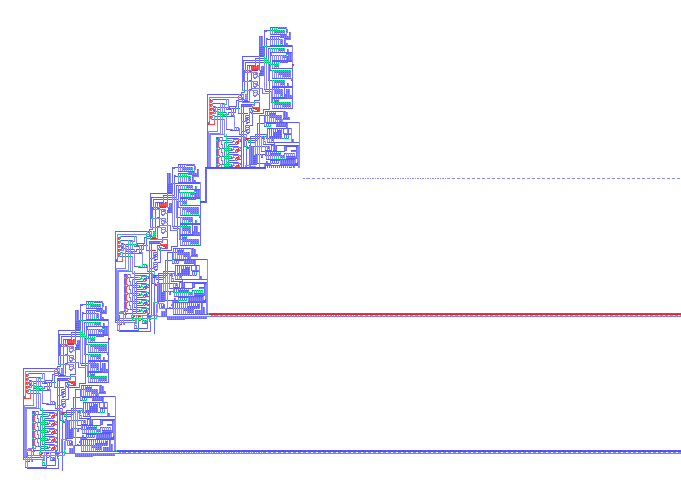
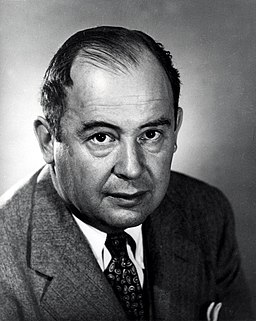
In the late 1940s, the concept of cellular automata was devised by John Von Neumann as a model for self-reproducing organisms.
Using this concept, in October 1970, mathematician John Horton Conway developed his Game of Life (or Life for short),
which debuted as a section in Martin Gardner’s column of Scientific American.
The Game of Life is able to display special patterns and behaviors,
including classifiable patterns such as “gliders”, “oscillators”, “still-life”,
and “spaceships”, which arise from just simple rules that Conway implemented in Life,
making the game capable of forming complex scenarios that can arise from a simple initial configuration.
Now this came to me as a "revelation." When I saw this kind of behavior, I thought of complex mathematical
equations, years of research, scientists and mathematicians pulling their hairs trying to find the perfect
configuration for each behavior. However, these phenomena can be produced from things as simple as making
a few gliders collide.
This potential for randomness, I believe, can be a perfect base for a warfare simulation,
in which cells would take over “unoccupied territory”,
form crucial supply lines for their “frontlines” and form skirmishes along the frontlines.
This website is a documentation of all the research that I have done for this topic. Keep in mind that this kind of research is not "practical"
in a sense that it can be applied into real life, but it is a research project that I had a lot of fun doing. I also had a lot of fun
creating this website as well, so it doubles as a way for me to practice my programming ;)